Thursday, June 10, 2010

Sepia Saturday #27
Wedding Day

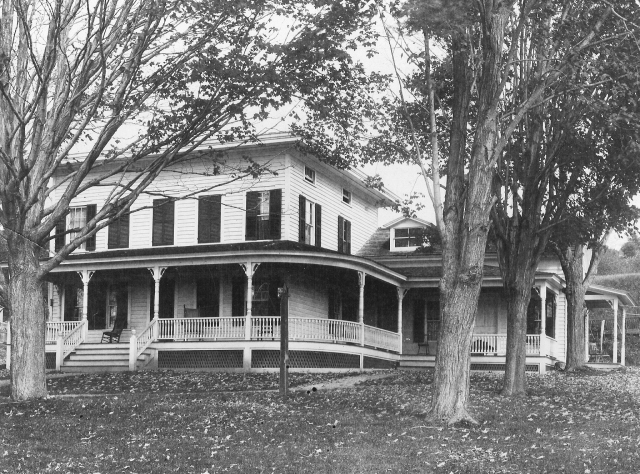
Remembering my parents
on their wedding day, June 12, 1943
Southfield, Massachusetts


My parents celebrated their 50th anniversary
June 12, 1993


In loving memory
Martha Louise Cook Stiles
8/28/1923-12/31/1994
Henry Raymond "Bud" Stiles
7/7/1920-5/11/2009

Friday, June 4, 2010

Sepia Saturday #26
The Great New England
Hurricane of 1938


From the family archives - photographs of the damage from the Great New England Hurricane of September 1938. Taken by my great grandfather, Howard Augustus Cook, in and around the Village of Southfield, Town of New Marlborough, Berkshire County, Massachusetts, New England! 

From Wikipedia The Free Encyclopedia:

"The New England Hurricane of 1938 (or Great New England Hurricane or Long Island Express or simply The Great Hurricane of 1938) was the first major hurricane to strike New England since 1869. The storm formed near the coast of Africa in September of the 1938 Atlantic hurricane season, becoming a Category 5 hurricane on the Saffir-Simpson Hurricane Scale before making landfall as a Category 3 hurricane on Long Island on September 21. The hurricane was estimated to have killed between 682 and 800 people, damaged or destroyed over 57,000 homes, and caused property losses estimated at US$306 million ($4.7 billion in 2009 dollars).  In 1951, damaged trees and buildings were still to be seen in the affected areas. To date it remains the most powerful, costliest and deadliest hurricane in New England history."

Massachusetts

The eye of the storm followed the Connecticut River north into Massachusetts, where the winds and flooding killed 99 people. In Springfield, the river rose to 6 to 10 feet above flood stage, causing significant damage. Up to six inches of rain fell across western Massachusetts, which combined with over four inches that had fallen a few days earlier produced widespread flooding. Residents of Ware were stranded for days and relied on air-dropped food and medicine. After the flood receded, the town's Main Street was a chasm in which sewer pipes could be seen.

To the east, the surge left Falmouth and New Bedford under eight feet of water. Two-thirds of all the boats in New Bedford harbor sank. The Blue Hills Observatory registered sustained winds of 121 mph and a peak gust of 186 mph.  The New Haven Railroad from New Haven to Providence was particularly hard hit, as countless bridges along the Shore Line were destroyed or flooded, severing rail connections to badly affected cities (such as Westerly) in the process.

Photographs ©2010 Property of Janice Stiles-Boults

Wednesday, May 5, 2010

Sepia Saturday #22 - "The Old Neighborhood Playhouse"


WWII Observation Tower (1940's). At the home of Palmer J. Cook, Southfield, MA. "Civil Defense efforts were largely manifested by the Defense Board and the Ground Observation Corps, a group of volunteers which, according to the New Marlborough Town Report of 1942, was headed by Palmer J. Cook, co-owner of Turner & Cook buggy whip factory in Southfield. The aircraft warning system used the structure pictured as an observation post... it was manned continuously 24 hours a day, and one of the few stations in this section of New England. It was discontinued in 1944.

The tower actually lived three lives. First as the WWII Observation Post; then it was moved just up the road where the fire department used the tower once again as an aircraft observation post... in the mid-1950's there was national concern that the US was vulnerable to atomic attack by the Soviet Union. The post's second life came to an end in 1957 when the DEW (Distant Early Warning) line system was completed and made operational.

The tower was acquired a few years later by a local resident and moved to their property on East Hill Road in Southfield. Its third and final life was a playhouse for the neighborhood children, and eventually razed in the 1980's." (Reported by David Lowman, NM 5 Village News, 2003).


A friend of mine commented on the photo: "How well I remember going up in the tower with your mom, and watching in awe as she would report what types of planes were flying over."

Another friend added this: "It was right where I built my house... it was torn down in about 1984... there wasn't much left of it, though, by then. We used to camp in it as kids, and somewhere I still have a few signs, and aircraft posters from it! Thanks, Jan... I'd love to see the video of it being moved!

©2010 Photographs property of Janice Stiles-Boults

Sunday, May 2, 2010

Rest in Peace Celinda...


1965 when Celinda was born; pictured here with her great grandmother, grandmother, and mother.  4 Generations.


1991 when Celinda returned home for a visit with her baby boy Shaun; pictured here holding Shaun is his great-great grandmother, and from left, his great grandmother, grandmother and mother Celinda.  5 Generations.

In loving memory of
Celinda Louise Allyn Lockwood
3/30/1965-4/18/2010


Gone too soon my niece
We miss your strength and beauty
Angel, rest in peace.

Sunday, April 25, 2010

Sepia Saturday #20 - "Steeplejack"


This is the Congregational Church in the village of Southfield, Town of New Marlborough, Berkshire County, Massachusetts, taken on July 31, 1926.

Last summer our church was being painted, and a big cherry-picker type machine sat in front of the church for several weeks so the painters could go up on a lift to paint the steeple.  I teased them, asking why they were not doing it 'the old fashioned way', because it would be less costly... I said with a wink, and then produced these photos for the church archives.

My great grandfather, Howard Augustus Cook (1870-1938) took these photographs when the Steeplejack came to town! 

Hope you can enlarge them to view the man at the very top.  The current painters told me there is still a large hook at the top that the Steeplejack used to attach the rope around his waist on the steeple while he painted.


Photographs property of Janice Stiles-Boults

Monday, April 12, 2010

Sepia Saturday #19 - My House in the Village

c:1930's

One hundred ten is a ripe old age, filled with a long history of family, community, joy, sadness, difficult times as well as prosperous; it is an age that my family home has reached this year. The “blue-haired lady” as I like to call her, is really a diamond in the rough, a house that is ready for rebirth and to welcome a new family. The Grande dame I refer to is the Howard A. Cook homestead located on the main street in the village of Southfield. It is with sadness that I now write about the ending of an era, the cleaning out and closing down of my childhood home. The house has seen five generations of the Cook and Stiles families celebrate births, weddings, holidays, and deaths for over a century. Sadly we have to let her go, and she is for sale for the first time in her history.

c: late 1800's

Howard Cook and his siblings grew up in Southfield, in a lovely Federal style house (photo above) built in the early 1800’s by his father, James Monroe Cook. This house, which burned down in the 1960’s, was located on the empty lot between the church and my family home. Southfield was the only place Howard had ever wanted to live, even after all of his travels around the country. He was stepping into the family business of rawhide manufacturing at Turner and Cook, and knew he wanted to stay in his hometown. He married a local girl that grew up in the “Palmer house” (now the home of Joby Baker and Dory Previn) and settled down to raise a family and run the company as its President and Treasurer.


c: 1900

It was in 1898 that H.A. Cook decided to build his own large country house, in an age of splendor and opulence: it was the late Victorian period. He purchased land next door to his father’s house, and set about designing his own home. The place has some of the influence from the Victorian period throughout the interior, but its exterior is not as ornate as early Victorian houses were; it may be considered Folk Victorian or Colonial Revival. Reflecting American patriotism and a desire for simplicity, the Colonial Revival house style remained popular until the mid 1950's and between World War I and II it was the most popular historic revival house style in the United States.

c:early 1900's

Our house has twelve rooms, not counting the sleeping porch and the one (and only) bathroom on the second floor. Kitchens and bathrooms were small and not a focus for houses built at that time. The lady of our house would not have concerned herself with the kitchen, since she wasn’t going to be spending much time in there – the Cook’s, considered to be wealthy, had servants. The kitchen is very plain and simple; there is an old dumb waiter, as well as a boarded-up china cupboard that once opened from both sides into the dining room from the kitchen. This would be were the maid would pass trays through to the dining room without having to disturb the family. We discovered a button on the floor under the dining table that was used by Mrs. Cook to summons the maid, and her guests would think that the maid just magically appeared exactly when needed. A very long and large pantry connects the kitchen and dining room, another way that servants could come and go with the least amount of intrusion on the family and guests. There is a very steep and narrow back staircase in the kitchen that the family in the early 1900’s would not have used, as this was the staircase the maids would climb to their quarters over the kitchen.


c:1930's

This house was built for entertaining, and that is exactly what they used it for. Howard was a socialite, entrepreneur and industrialist, and had houseguests on a regular basis. Over the years, many fancy parties, weddings and funerals took place. Howard and his wife raised five children in the house, with one daughter having a grand wedding ceremony and reception. Another, who was an accomplished pianist and music teacher, held many recitals at the house. Originally it was only a summer home for the Cooks, who would ‘winter’ in Great Barrington so that all their children could easily attend school at Searle’s Castle. (The drive to Great Barrington was not a simple thing to do at the turn of the century). It also was only used in the summer because when it was first built, there was no electricity in town - a few old gas jets from the pre-electricity days are still visible. My parents, who moved into the house in 1952, also raised five children at the old homestead. We are fortunate to have a pictorial history throughout the one hundred ten years it has been in our family.


All the rooms on the first floor are very large, with high ceilings and windows that still retain the original wavy glass. The formal parlor at the front of the house was always “the music room”: we had a lovely grand Steinway piano where I spent many hours practicing. The Victorian era was noted for heavy dark paneling and moldings; in our dining room, the wainscoting is elegant, and the built-in cupboards with leaded glass panes are impressive. The greatest feature of our home is the wraparound porch; there was always a family member or two to be found sitting on the old porch swing on summer afternoons and evenings. My mom would have buckets of flowers and hanging pots of fuchsias on all three porches of our house. In the front hallway, where a beautiful staircase of carved cherry wood curves up to the second floor, there is a stained glass window – a typical ornamentation in this period – as well as many decorative brass and glass doorknobs. (photos above, c: early 1940's).

The upstairs has five bedrooms, several being very large, which gives the whole house an open and airy feeling, with great light from its many windows. My favorite spot, however, was the sleeping porch. In the Victorian era sleeping porches on the second floor were very common, and were used as a form of air conditioning against the summer heat. I would move out to the sleeping porch every spring, and with its position at the back of the house away from the afternoon sun, it would remain very cool. Three walls of the room were fitted with large screens to let in plenty of fresh air. It was so wonderful to awaken to the morning sun peaking over the mountain and shining into the porch; the air was clean and fresh, and the sounds of the birds and animals of the woods could be heard clearly. I’ll never forget lying in bed watching the stars at night, or the peaceful stillness of those early mornings.
c:1950's

c:1969, shows several of the Elm trees that lined Main Street,
which eventually were taken down due to Dutch Elm Disease.

Now the old house is tired and worn out, and in need of tender loving care. We have emptied all the rooms and the realtor’s sign has gone up in the front yard. The first holiday, seeing it dark and empty was quite heart-wrenching, as there have always been family gatherings at this house for over one hundred years. Wandering through the rooms on Christmas Eve with the full moon light shining in every window, I felt very nostalgic for all the past holidays. These memories are my lifetime and the house is part of my heritage, and even when I no longer own it, all the happy times are forever in my heart. When the old blue-haired lady is gone from our family the loss will be felt by all of us, but she will not be lost: someone will bring her back, revive and restore her, so that they can begin their own history and memories of life in the H.A. Cook homestead.


c:1984

c:1985

c:1996
Used as a Christmas Card by Henry Raymond "Bud" Stiles,
the last one to live at the old homestead.


And, the big old wraparound porch hosted many a party throughout the years.
The above photos being the 80th birthday party for my father, Henry Raymond "Bud" Stiles.
c: July, 2000


©2010, Janice Stiles-Boults
Previously published, ©February, 2008
New Marlborough 5 Village News

Friday, April 9, 2010

Sepia Saturday #18 Centennial Plate


1905 Knox 2-cylinder Model D.  Issued plate #9429 upon registering.
First car in the village of Southfield, MA
Howard A. Cook Family
1930's Howard A. Cook homestead
and another car with the 9429 plate.
Southfield, MA
 1942, Palmer J. Cook takes over #9429
Southfield, MA
1950's Palmer J. Cook
Southfield, MA
1957 Blizzard, Southfield, MA
My truck, carrying on the tradition!


New Marlborough, specifically the village of Southfield, is my hometown, and I take great pride in the deep roots my family has had in this area since the late 1700’s. I grew up in a house on what was then called Main Street (now Norfolk Road), built by my great grandfather in 1898, and family owned for over a century until it was sold in 2008. I also grew up with four numbers - 9429 – being an integral part of my family’s legacy and tradition. Our silver Dodge pick-up holds the Massachusetts license plate bearing these numbers.

There is a story behind that license plate; we celebrated the centennial of it being a family-owned license plate number in 2005. According to the Massachusetts Registry of Motor Vehicles, Massachusetts first began issuing licenses and registration plates in June of 1903 under Chapter 473 of the Acts of 1903. The first plate, featuring the number “1” printed on it, was issued to Frederick Tudor in 1903, and is still held as an active registration by a member of his family.

Our plate number, 9429, falls within the issue year of 1905, and only five family members have been registered owners of that number over the last one-hundred years. In 1905, my great grandfather, Howard A. Cook (at one time president of the Turner and Cook Buggy Whip Manufacturers), bought the first car in Southfield. It was a Knox 2-cylinder Model D, and upon registering the vehicle, he received the plate number 9429.

When Howard passed away in 1938, his son Palmer J. Cook, a resident of Southfield, took over the plate. Eventually in the early 1960’s, Palmer retired from his position as president of Turner and Cook and moved to Cape Cod – the plate went with him, being the first time in fifty-five years that it had left Southfield. Upon Palmer’s death in 1970, the plate went to his daughter, Martha Cook Stiles, my mother, and came back to Southfield where my parents continued re-registering the number. Mom died in 1994, and dad (“Bud” Stiles) continued with the ownership of the number until he relinquished his driver’s license and registration plate in 2003. At that time, I was given the opportunity to carry on the number and so it was transferred into my name.

Being a great grand-daughter of Howard Cook, I am the fourth generation to own the license plate number 9429, and the only direct descendant of the Cook family to still live in Southfield.  I am very proud that I can keep that number “at home” where it originated. It is an honor to be a part of a long-standing legacy from the first car in Southfield in 1905, to the 100th anniversary of the number plate in 2005, and beyond, carrying on the tradition.

An interesting bit of history - the car purchased on this receipt might be
the one in the second photograph.  I'm sure that the automobile 'buffs'
out there would recognize the make and models.
We should all get to buy a brand new Cadillac for $1700.00!

©2010, Janice Stiles-Boults, all rights reserved.
Previous edition published in the
New Marlborough 5 Village News,
December 2005.